
2201 Dupont Dr., Irvine, CA 92612
© 2026 Glidewell. All rights reserved.
800-854-7256 USA
How Glidewell's early investment in foundational technologies has shaped the evolution of dentistry and improved how clinicians deliver care.

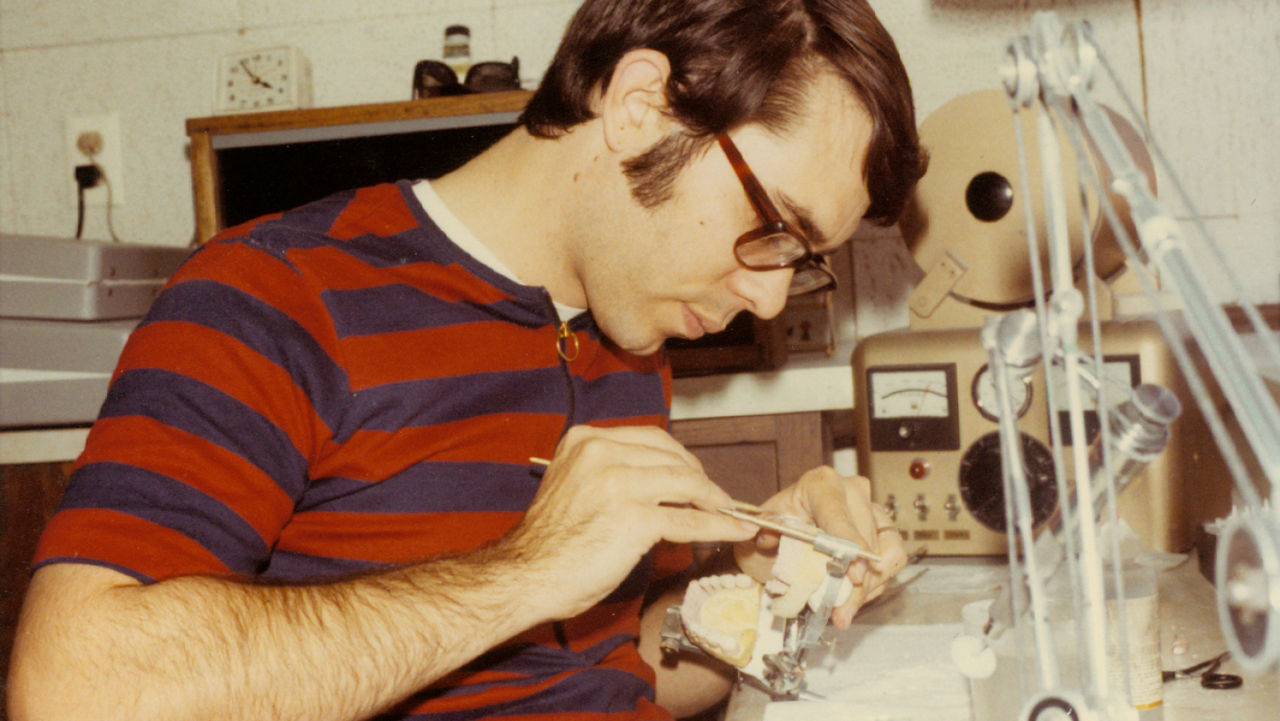
In January 1970, Jim Glidewell started a one-man dental lab at his kitchen table. There was no CAD software, no milling machines, no AI. Just wax, porcelain, and a belief that dentistry could be done differently. The traditional craft model produced good work, but it also produced variability, inconsistency, and costs that put high-quality care out of reach for too many patients. Those were the problems he set out to solve by making a better system.
What followed was a series of innovations, each building on the infrastructure before it, expanding what was possible for dentists and redefining how care could be delivered to patients.
Jim’s instinct was right. It was also about 40 years ahead of its time.
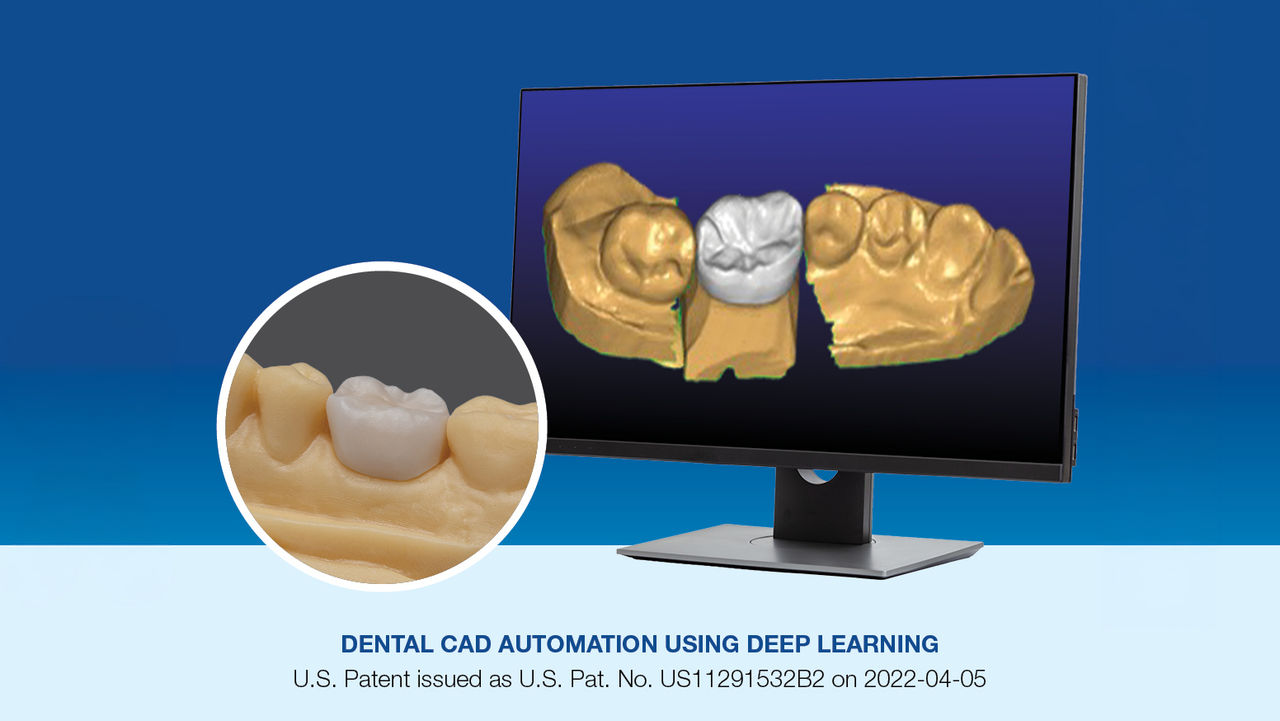
When it comes to new technology, most companies wait until the rest of the industry is ready to follow. Glidewell has taken a different approach by building the infrastructure early, often before the conversation has had time to catch up.
In 2007, while most labs were still working from physical impressions, Glidewell accepted its first digital case. By 2015, when AI was still largely in the research phase, a dedicated machine learning team was already in place at the company’s headquarters. And in 2017, Glidewell milled the first crown designed entirely by a generative adversarial network — an approach later referred to as “GANufacturing,” and one of the earliest examples of physical AI in practice. In the years since, the same foundational approach of large-scale clinical data, in-house engineering, and continuous refinement through real-world feedback has been extended to virtually every stage of production.
Today, more than 95 percent of Glidewell's restoration proposals are AI-generated. Automated manufacturing operates at 20-micron tolerances, and machine vision systems track every unit through quality control and shipping. With every case that comes through the door, the system learns and improves.
What started at a kitchen table is now a million-square-foot campus in sunny Southern California. And one technician has become thousands. The traditional craft model that defined dental labs for decades has evolved into something entirely new. It was built over time, before the industry had a name for it.
Since accepting its first digital case in 2007, Glidewell has accumulated more than 30 million cases in its cloud-based infrastructure. That number isn’t just a stat. It’s the dataset that powers and continuously improves every AI system Glidewell runs.
This is what a real data moat looks like. It can’t be bought, and it can’t be built overnight. No new entrant to digital dentistry, no matter how well funded, can replicate 30 million cases of real-world clinical data.
And it keeps getting stronger. Every new case adds to the system, making it smarter over time. Simply put, as innovation speeds up, the gap will continue to grow between companies that built AI into their foundation and those that added it later as a feature.
For most of dentistry’s history, the lab and the operatory have been separated, connected only by a prescription slip and a courier. That model is starting to change.
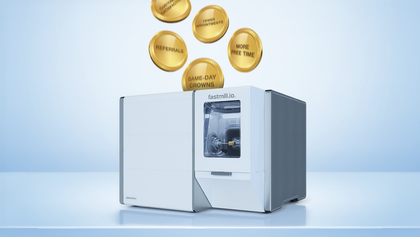
Glidewell is rethinking what the lab’s role can be. The launch of the glidewell.io™ In-Office Solution in 2018 marked a significant step in that shift. It moved AI-powered design and chairside milling into the practice, powered by the same infrastructure and data as the central lab. That means a dentist can design and produce a restoration to Glidewell’s standards in a single visit.
That same innovation extends beyond the practice itself. Services like Next-Day BruxZir® Zirconia crowns compress timelines from the lab side, turning around a finished restoration by the next morning. And with Glidewell Signature™ that same shift extends into the patient experience, allowing dentists and patients to review, approve, and refine esthetic treatment designs in real time with laboratory support at each step. A process once invisible to the patient and happening off-site becomes a shared, interactive part of the clinical conversation.
These aren't just individual solutions. They signal something larger: the lab is no longer just a place where cases are sent. It's becoming an integrated clinical partner, involved at more points in care and more connected to the patient experience than ever before.
As Glidewell continues to evolve, it’s becoming a true platform — an integrated infrastructure where an expanding set of capabilities are built, connected, and continuously improved. The dental laboratory remains at the center, but it is no longer the boundary.
As AI evolves, so do its applications and use cases. The next frontier is the appliance itself.
Until now, oral appliances from mouthguards and sleep devices to occlusal splints have been passive. They’re made, fitted, worn, and eventually replaced. They don’t generate data or communicate with the clinician between visits. They serve a purpose, and that’s where it ends.
But with AI, that’s beginning to change in a meaningful way. With Glidewell’s latest technology, oral appliances are becoming smart. ORB Sport™ Smart Mouthguard can track heart rate, movement, and head impacts in real time. For athletes, that means coaches and trainers now have access to objective data during practices and games. These kinds of insights simply didn’t exist before.
And Glidewell isn't stopping there. Similar sensor technology will be applied to other oral appliances, as a means of better understanding patient health indicators between appointments.
This isn’t just a better appliance. It’s a new category — one that generates clinical insight, not just clinical function.
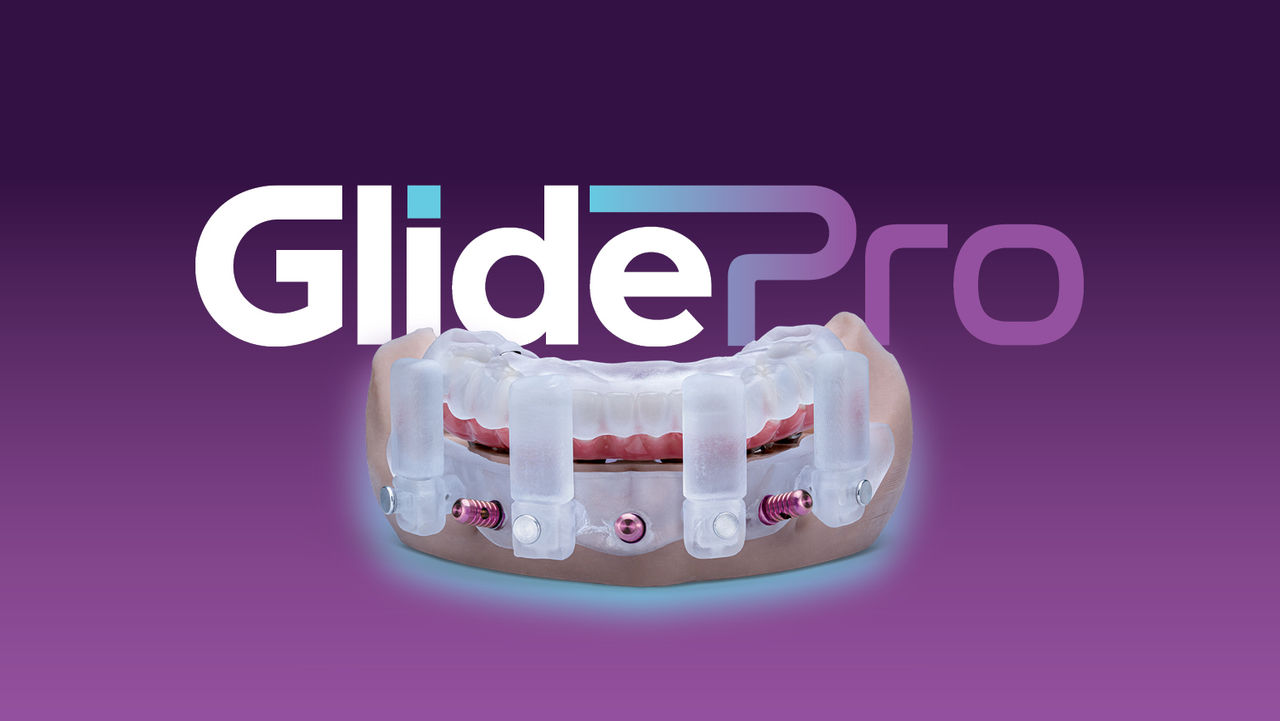
The intelligence Glidewell is building extends beyond the appliance itself. The same thinking is now reshaping entire treatment workflows, particularly in complex procedures like full-arch implant restoration where precision is critical.
Full-arch cases have long been among the most technically demanding in restorative dentistry, requiring seamless coordination across surgical planning, prosthetic design, and manufacturing, with little room for error at any stage.
Glide Pro™ Guided Surgery is Glidewell’s answer to complex full-arch workflows. It integrates digital scanning, wax-up planning, precision manufacturing, rapid 3D printing of surgical guides, and chairside execution of same-day provisionals into a single seamless system. Rather than passing cases back and forth, the surgeon, restorative dentist, and lab work together in a shared digital space that preserves the treatment plan from the first scan to the final restoration.
For patients, this means smoother surgeries, same-day provisional teeth that work right away, and final restorations planned with the surgery — not retrofitted afterward.
The conversation around AI in dentistry today is mostly focused on individual tools from a crown design feature and a caries detection algorithm to a radiograph reader. These are valuable, but they’re only part of the picture.
At this point, the real question isn’t whether a company uses AI, since every business eventually will. What matters is how deeply AI is built into the entire clinical and operational workflow, and how much data over time is powering it.
At Glidewell, AI isn’t layered on top of existing products. It’s built into the foundation. It supports everything from design and manufacturing to quality control, equipment maintenance, and case management. The same system that generates crown proposals can also monitor milling performance, predict maintenance needs, flag quality issues in real time, and route cases efficiently through production.
As that system learns and improves, everything connected to it improves continuously, and at scale.
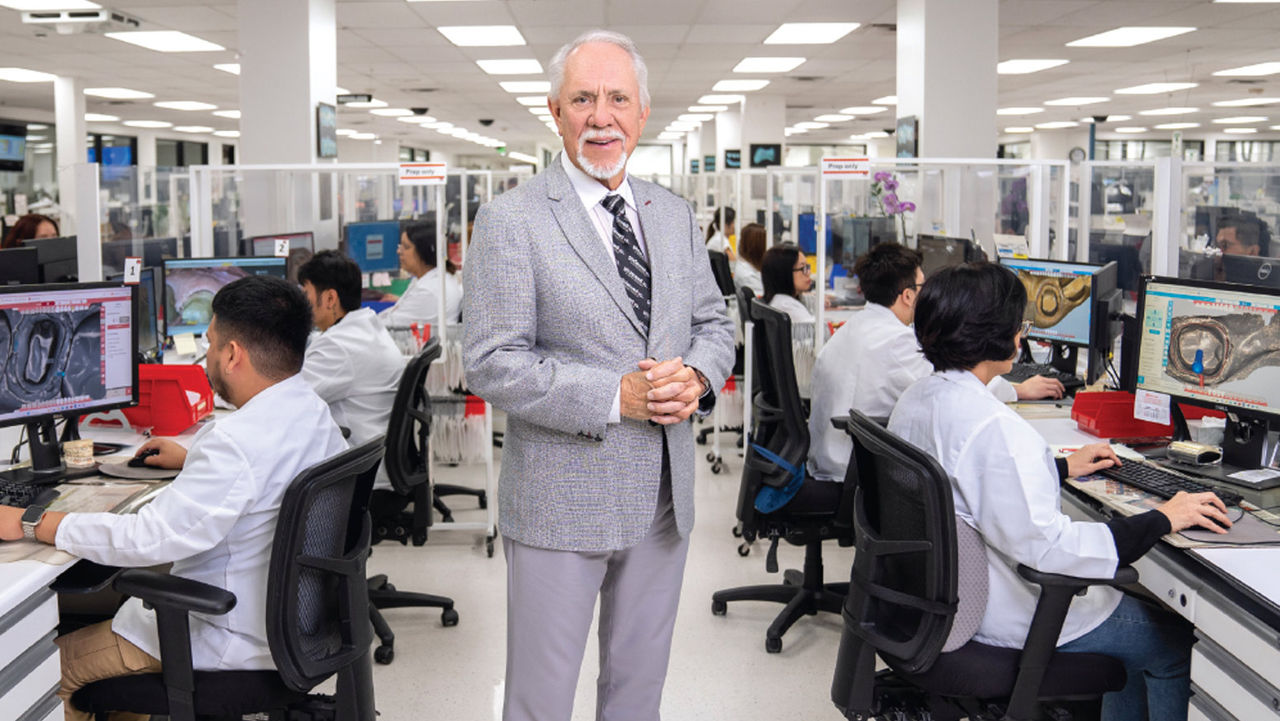
The dental practice of ten years from now is going to look very different from today. The labs that support it will change even more. The line between the two will continue to blur, with data from every restoration, appliance, and patient interaction flowing more easily between the practice and the lab. AI will play a bigger role in clinical decisions, and the appliances dentists prescribe will start generating the data that helps guide those decisions.
Choosing a lab partner isn’t just about who makes your crowns this week; it’s about the infrastructure you’re connecting to, and whether it’s built for the future you want for your practice.
The practices and DSOs that will be best positioned over the next decade are making those decisions now, with a clear view of where dentistry is headed, not just where it’s been.
When you partner with Glidewell, you're connecting to infrastructure that's already been building that future for over 55 years — consistently, and often ahead of the industry. There’s more to come, but the foundation is already in place.
Explore Glidewell’s full suite of restorative, digital, and platform solutions at glidewell.com, or connect with a representative to see how it can support your practice.
Send blog-related questions and suggestions to hello@glidewell.com.
/GL-DB-6859919-080426-1.jpg/_jcr_content/renditions/thumb-jpeg-mobile-full.jpeg)

2201 Dupont Dr., Irvine, CA 92612
© 2026 Glidewell. All rights reserved.