
2201 Dupont Dr., Irvine, CA 92612
© 2026 Glidewell. All rights reserved.
800-854-7256 USA
How AI-powered remote monitoring is changing what profitability actually means in aligner therapy


Clear aligner therapy has rapidly evolved from a niche offering into a mainstream service across both private practices and large DSOs. Patients increasingly prefer it for its esthetics and convenience, while doctors value it as a predictable and attractive revenue stream. Adoption continues to grow year after year, yet one persistent concern continues to shape decision-making: cost.
For many providers, the perceived barrier to broader adoption isn’t clinical effectiveness or patient demand—it’s the lab fee. It’s tempting to assume that if aligner therapy were simply less expensive per case, utilization would naturally increase. But that assumption overlooks a more important reality: the true economics of aligner therapy have very little to do with shaving a few hundred dollars off the cost of trays.
Instead, the real drivers of profitability and scalability are far more operational—efficiency, patient compliance, and the ability to reduce unnecessary appointments. That’s where the most meaningful opportunity exists.
In many practices today, aligner treatment still follows a traditional model. Patients are routinely scheduled for periodic in-office visits to monitor progress, even when treatment is proceeding exactly as planned. While these appointments may seem minor, they quietly consume one of the practice’s most valuable resources: chair time. These visits typically generate little to no additional revenue, yet they occupy clinical and administrative bandwidth that could be directed toward higher-value procedures.
From the patient’s perspective, the experience is not ideal either. Frequent check-ins can feel unnecessary and inconvenient—especially when everything is on track. Modern patients increasingly expect healthcare experiences that are efficient, digitally connected, and minimally disruptive to their daily lives. Practices, in turn, are seeking ways to deliver care that is both scalable and operationally streamlined.
This raises an important question: how can clinicians maintain appropriate oversight of treatment without filling their schedules with visits that add limited value?
The answer, in our view, lies in rethinking the role of monitoring within aligner therapy.
What fundamentally differentiates Glidewell Clear Aligners is not just the appliance itself, but the integration of AI-powered remote monitoring through ProMonitoring™. With this system, patients use their smartphones to scan their teeth at regular intervals. These scans are analyzed by AI to assess whether tooth movement is progressing as planned and whether the patient is ready to advance to the next aligner.

If treatment is tracking properly, both the patient and the practice are notified to proceed—no office visit required. If movement deviates from the plan, the system flags the issue, instructs the patient to remain in their current aligner, and prompts a follow-up scan. Meanwhile, the doctor and team maintain full visibility through a centralized dashboard that allows them to monitor progress across their entire patient base.
The goal is straightforward: when treatment is progressing normally, there is often no clinical reason for the patient to return to the office simply for a routine check or to pick up the next set of aligners. Eliminating these unnecessary visits has a profound impact on practice economics.
Efficiency is quickly becoming the defining competitive advantage in aligner therapy. The future will not be determined by who can produce the lowest-cost tray, but by who can create the most streamlined path to successful outcomes.
Reducing unnecessary appointments unlocks several key benefits. Practices gain increased chair availability, allowing them to focus on higher-value procedures. Patients experience fewer disruptions to work, school, and family life. Digital engagement improves, as patients can actively track their progress through tools they already use every day. At the same time, AI-driven monitoring enables earlier detection of issues such as poor tracking, tissue irritation, or hygiene concerns. Perhaps most importantly, practices can scale their aligner offerings without proportionally increasing operational strain.
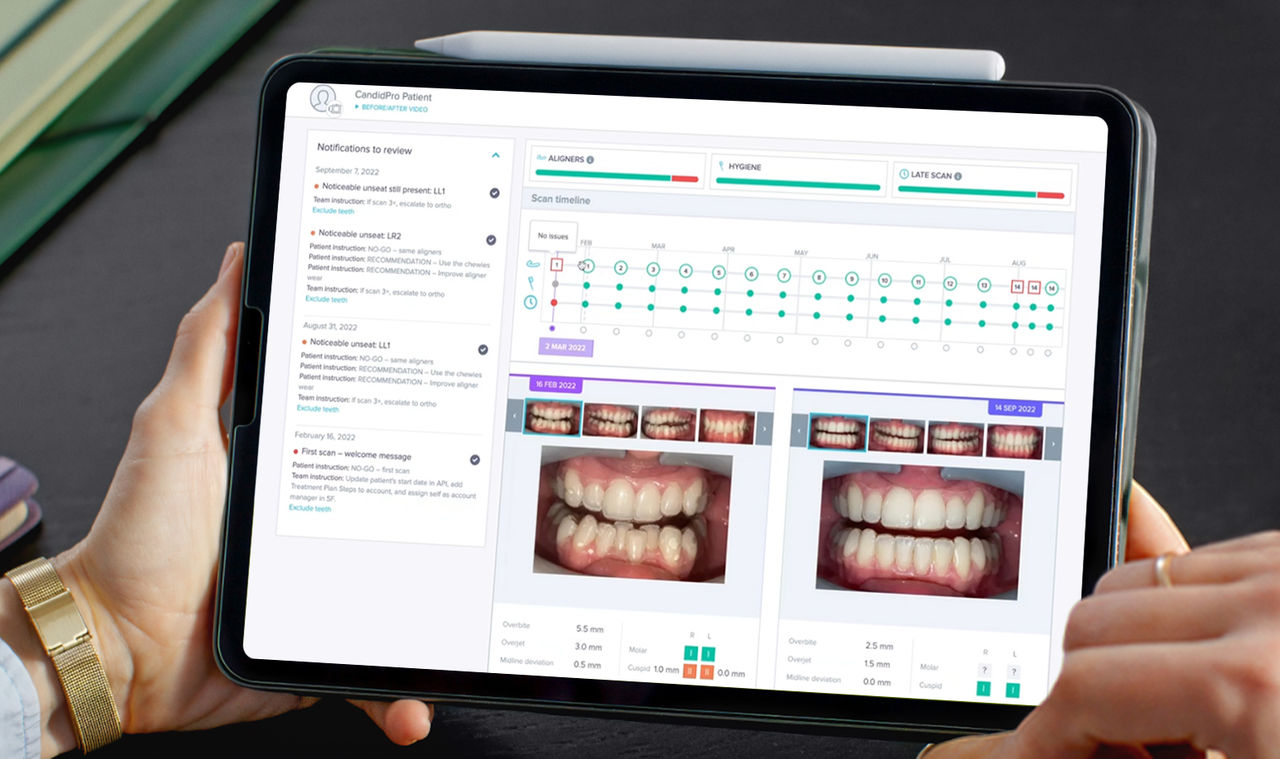
Taken together, these advantages often deliver a far greater financial impact than incremental savings on lab fees alone.
This philosophy guided Glidewell’s approach from the beginning. For years, customers asked why Glidewell had not entered the aligner market. The answer was simple: entering the space required more than just manufacturing trays. It required a meaningful improvement to the overall treatment model.
Before launching Glidewell Clear Aligners, extensive time was spent evaluating technologies, workflows, and potential partners. The system was introduced through a nine-month soft launch with select clinicians, allowing real-world feedback to shape its development. What consistently stood out during this phase was not just clinical performance, but the operational efficiency and patient engagement the monitoring workflow created.
In addition, many doctors were drawn to a treatment philosophy that emphasized simplicity and patient comfort. In many cases, this translated to fewer attachments, less interproximal reduction, and a more patient-friendly experience. Combined with AI-driven monitoring and fewer unnecessary appointments, the result is a system designed not just to move teeth effectively, but to improve the experience for both patients and providers.
The operational advantages of AI-powered monitoring are clear, but it's worth stepping back to examine what that efficiency actually means in concrete financial terms. The national average fee for clear aligners is $5,108 — and Glidewell offers cases at a flat rate of $1,399, with no volume commitments required. Unlike competitors that adjust their per-case pricing based on how many cases a provider submits — effectively penalizing lower-volume practices — Glidewell's straightforward pricing gives doctors full control over what they charge patients. That flexibility, measured against the national average, translates into substantial margin potential for practices of any size.1
Clear aligners will continue to evolve, but the conversation surrounding them needs to mature as well. Rather than focusing solely on cost per case, practices should be asking a more strategic question: which system enables greater efficiency, stronger patient engagement, fewer unnecessary visits, and scalable growth? With Glidewell™ Clear Aligners, treatment plans are designed by U.S.-based orthodontists, allowing GPs to focus on reviewing and approving cases rather than spending valuable time designing them from scratch.
Because ultimately, the real cost in aligner therapy isn’t the tray.
It’s the time.
To get started with Glidewell Clear Aligners, visit glidewelldental.com/solutions/clear-aligners
CareCredit. (n.d.). Invisalign cost & Invisalign financing. Retrieved from https://www.carecredit.com/well-u/health-wellness/invisalign-cost-invisalign-financing/
Send blog-related questions and suggestions to hello@glidewell.com.
/GL-DB-6859919-080426-1.jpg/_jcr_content/renditions/thumb-jpeg-mobile-full.jpeg)

2201 Dupont Dr., Irvine, CA 92612
© 2026 Glidewell. All rights reserved.