
2201 Dupont Dr., Irvine, CA 92612
© 2026 Glidewell. All rights reserved.
800-854-7256 USA
Discover how Glidewell engineered an automated glazing process that delivers a consistently smooth, precision-controlled finish on every crown.

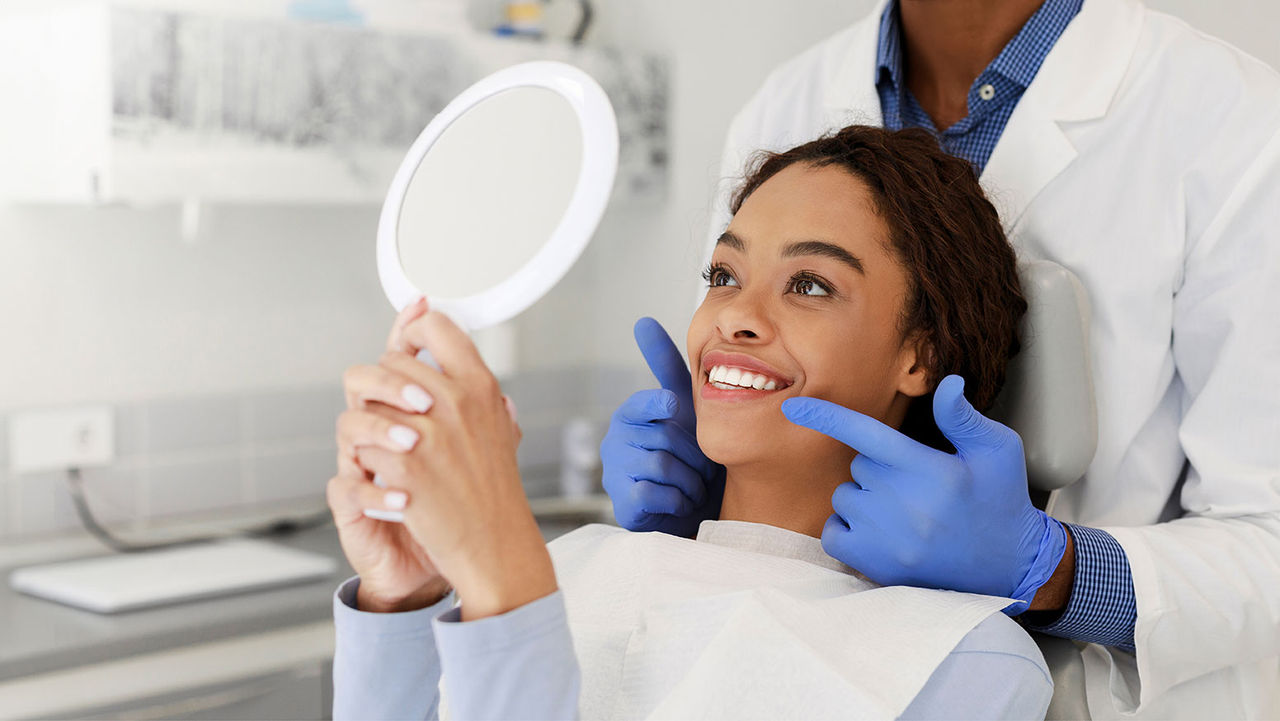
When a dentist seats a new crown, the patient does the same thing almost every time. They run their tongue over it. Before they see it in a mirror, before they bite down, they feel it. One doctor put it plainly at one of our seminars: the look is not what he’s after. It’s how the crown feels in the patient’s mouth. If it’s smooth, it feels right.
That moment of tongue-on-porcelain is the end point of a process most dentists never think about: glazing. And for decades, it was one of the least controlled steps in any lab.
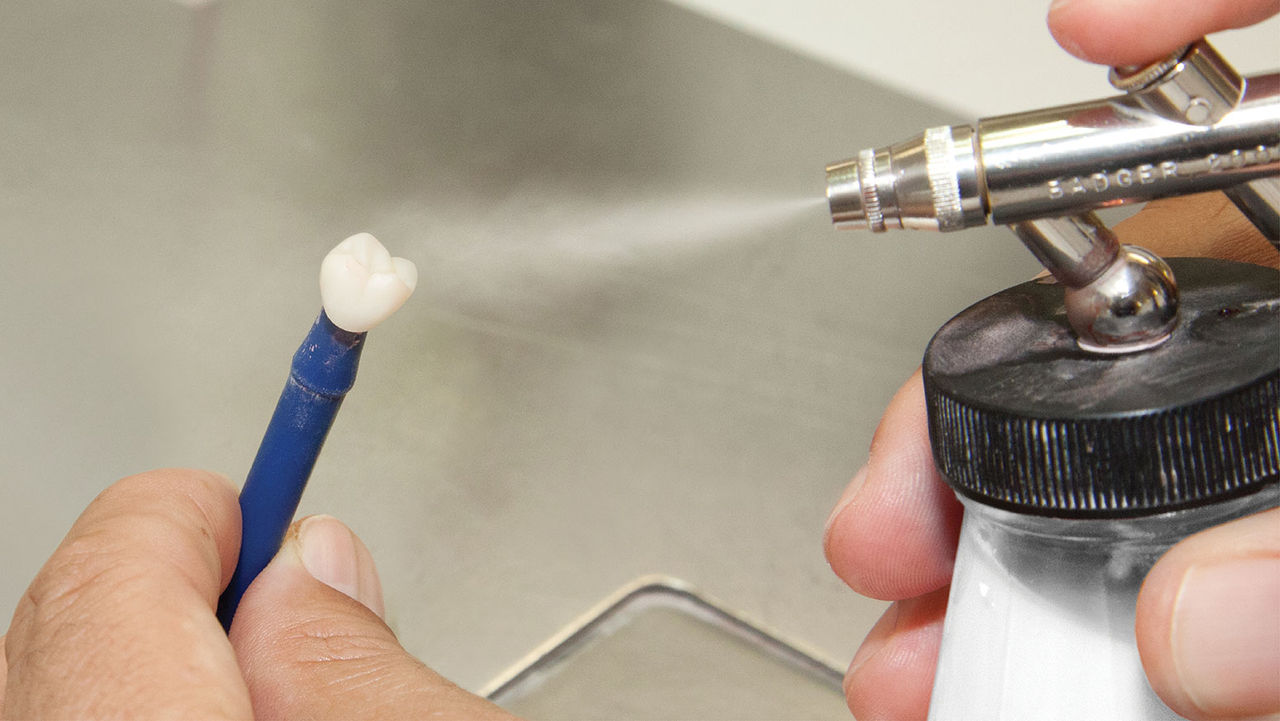
For most of our history, glazing looked the way it still does in labs everywhere. Glaze powder mixed with alcohol, loaded into an artist’s airbrush, sprayed onto a crown held on a wax post. One hand rotates, the other sprays. The alcohol evaporates and leaves a white layer of powder so uniform in color that no one can tell how thick it is. We had departments full of skilled technicians doing this, ten or twenty in a room, every day.
The workaround was food coloring. Tint the solution, spray it on, and judge the thickness by how pink the crown looks. Too red, too light or just right. It helped, but it was entirely subjective. Training a new technician meant trying to explain what the optimal shade of pink looks like. Downstream, our QC checkpoints were polishing excess glaze off crowns by hand. Eventually the variability pushed all the way back into design, where we were adjusting crown parameters to accommodate the manual glaze process. We were changing the foundation to suit the paint.
We wanted to find a more reliable way to improve results, so we ran a test. Ten crowns, identical design, handed to multiple departments with the same instructions. We sent the finished crowns to an independent materials lab, where they were sectioned and measured under an electron microscope. The glaze thickness was all over the place, between departments, between technicians, and even across crowns sprayed by the same person. That wasn’t a skill problem; our technicians are good. It was the ceiling of what hands can manage consistently, and we had hit it.
We resisted the urge to engineer a machine on day one. Our first moves were unglamorous: lock down the powder-to-alcohol ratio that had drifted into spoonfuls and pinches, fix the spray distance, fix the air pressure, and keep the ceramic powder agitated so it wouldn’t settle and clog the lines.
We also looked outside for help. Industrial spray equipment vendors had never seen our requirement: a coating measured in microns, held consistently across parts that are never the same shape twice. One vendor watched a demo and asked when the spraying would start, while it was already spraying. The layer was simply too thin to see.
That was the core of our problem. A crown is not a repeatable widget. Every unit we make is a custom product with its own width, height, occlusal depth, and surface area, and all of those features change how much material lands where. A larger crown needs more spray time to reach the same thickness. A deep central fossa behaves differently than a flat occlusal table. This is mass customization, and it breaks the standard automation playbook of one recipe, repeated forever.
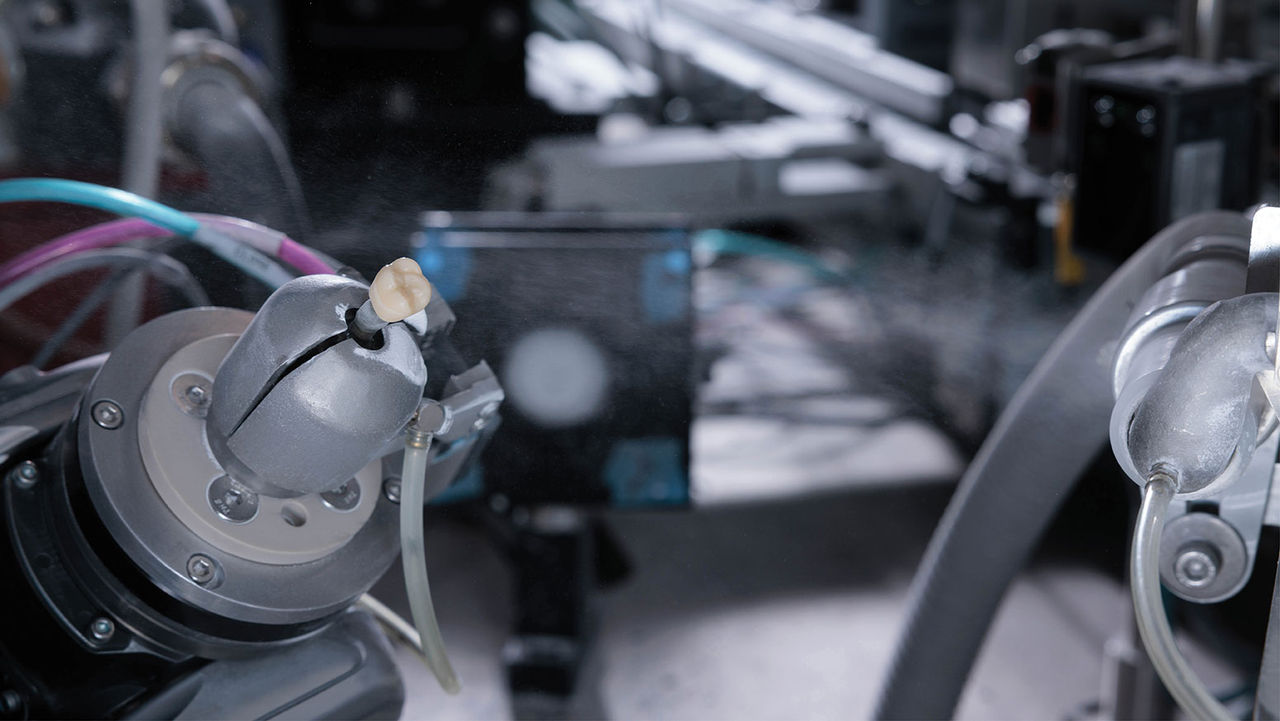
Instead of writing a recipe per crown, we built a proprietary algorithm that maps morphology to a pre-determined spray pattern. Think of it like a strike zone in baseball. It changes with every batter, but the rules for reading it stay the same.
Thickness is built up in calibrated passes, with volume, air pressure, standoff distance, and travel speed all correlated so that the finished layer lands on target, every time. The sequence matters too. Our patented process and sequencing approach enables our system to avoid uneven coverage.
Our first machine ran on a homemade circuit board built as a proof of concept. Later, as we proved the process, we put it into actual production.
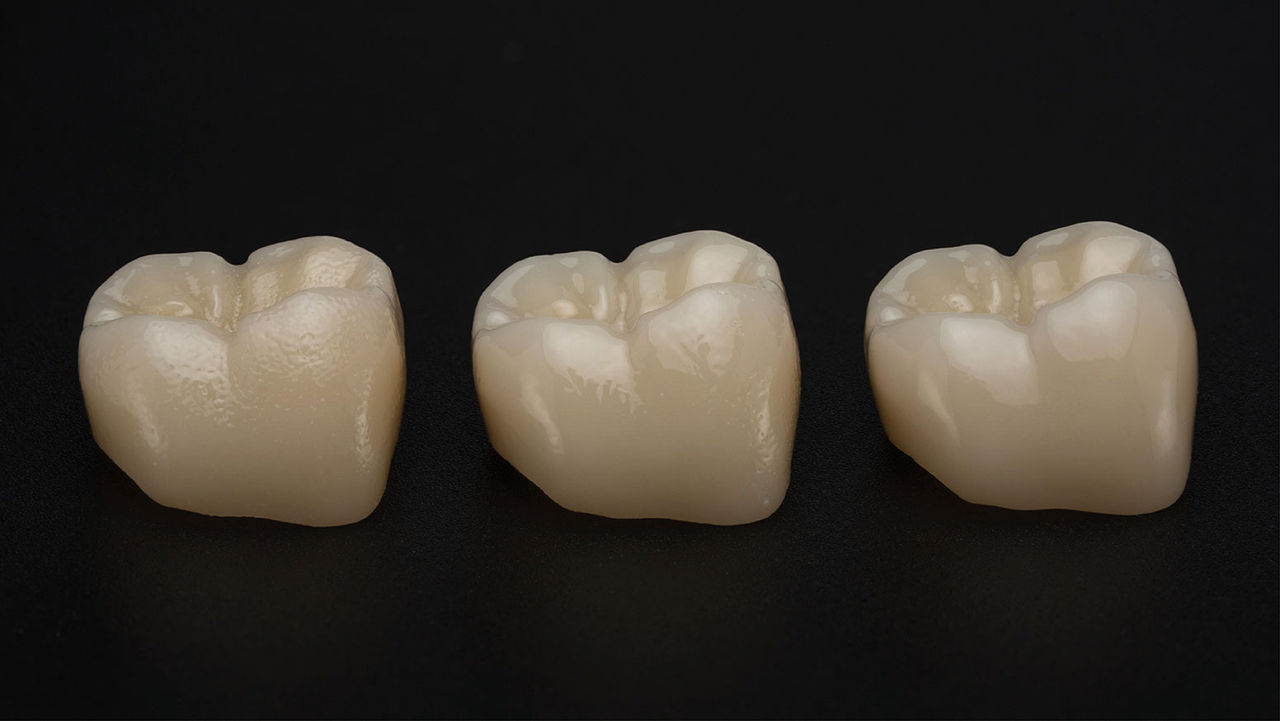
Then came the surprise. When we showed the machine-glazed crowns to our production teams, they were initially hesitant. The crowns looked flawless, and flawless read as wrong. Our technicians were accustomed to small inconsistencies that made a crown look natural. The uniform glaze was so smooth and reflective that everyone assumed it was thick. Sectioning told a different story: the machine layer was consistent and no heavier than typical hand application.
We determined the most optimal finish in thickness for the feel and appearance we wanted, and we held that tolerance to a fraction of the width of a human hair, day after day at production volume. The system defends that number actively: alcohol evaporation shifts the mixture ratio, vacuum suction builds up and bends the spray trajectory, and the machine compensates for both instead of letting them drift into the glaze.
And the dentists settled the esthetic debate for us. At one of our seminars, we handed attendees tabs holding three identical crowns glazed matte, medium, and gloss, and asked them to pick. The majority chose the glossy, machine-produced crown. The reason came back to the patient’s tongue.
Beyond glazing, our engineers developed a custom baking system. We used standard industrial best practices to optimize the baking process for maximum throughput and efficiency, and we landed with something much different than the typical batch ovens available for labs off the shelf.
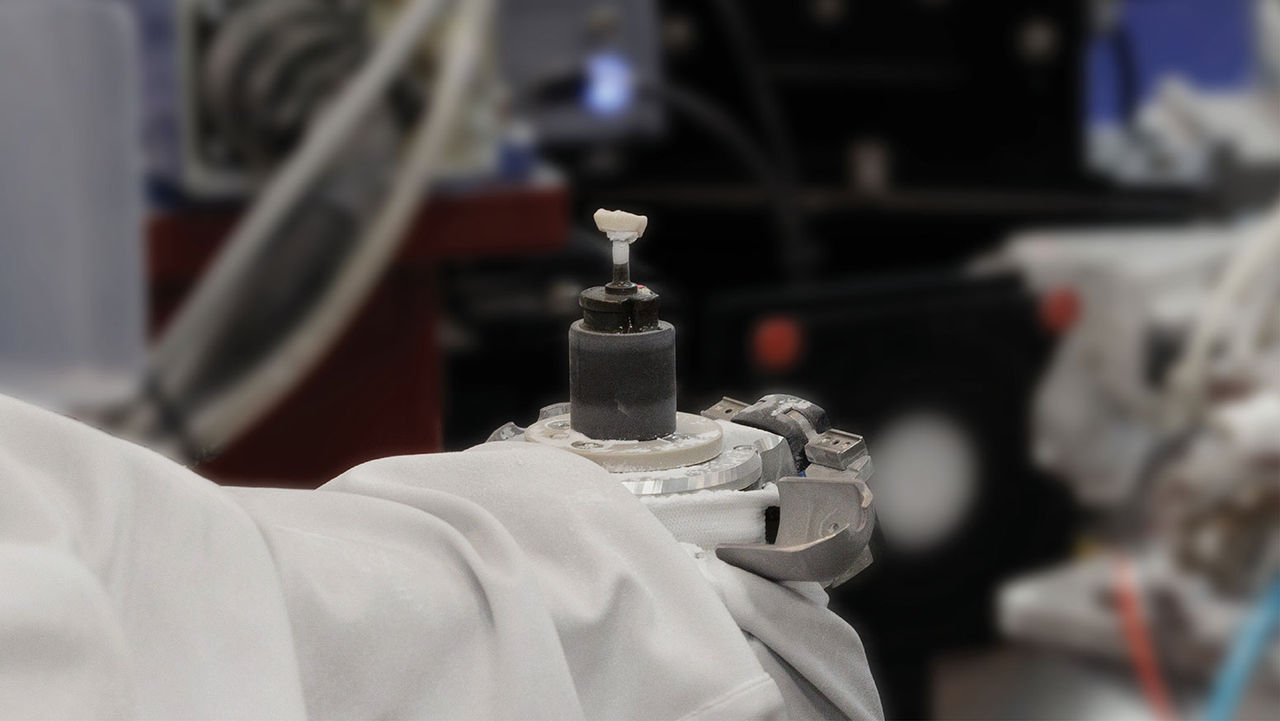
Our current-generation machine adds handling articulation and runs more self-sufficiently, retiring the ritual we liked least: the manual calibration a technician had to run at the start of every shift. The system now examines its own outcomes, offsets are applied automatically, and we’re ready for take-off. The result means that every crown is handled in the most optimal way, and every finishing cycle is applied with the most desirable results.
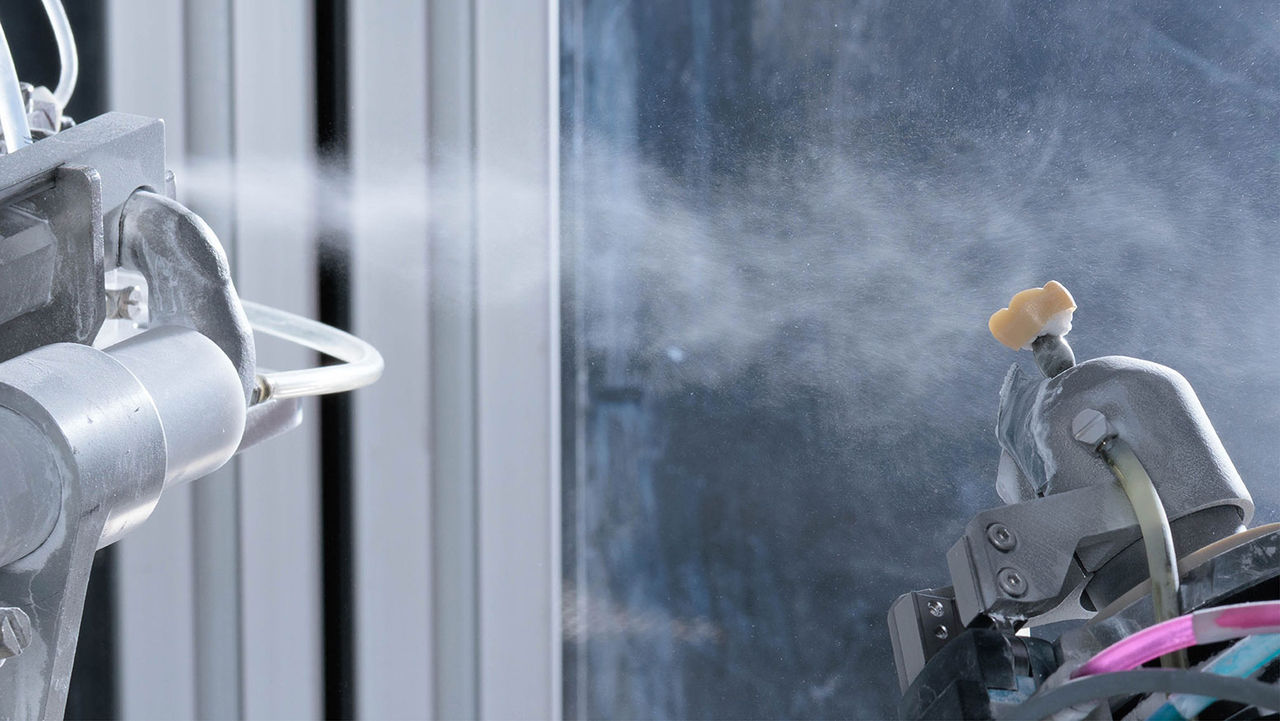
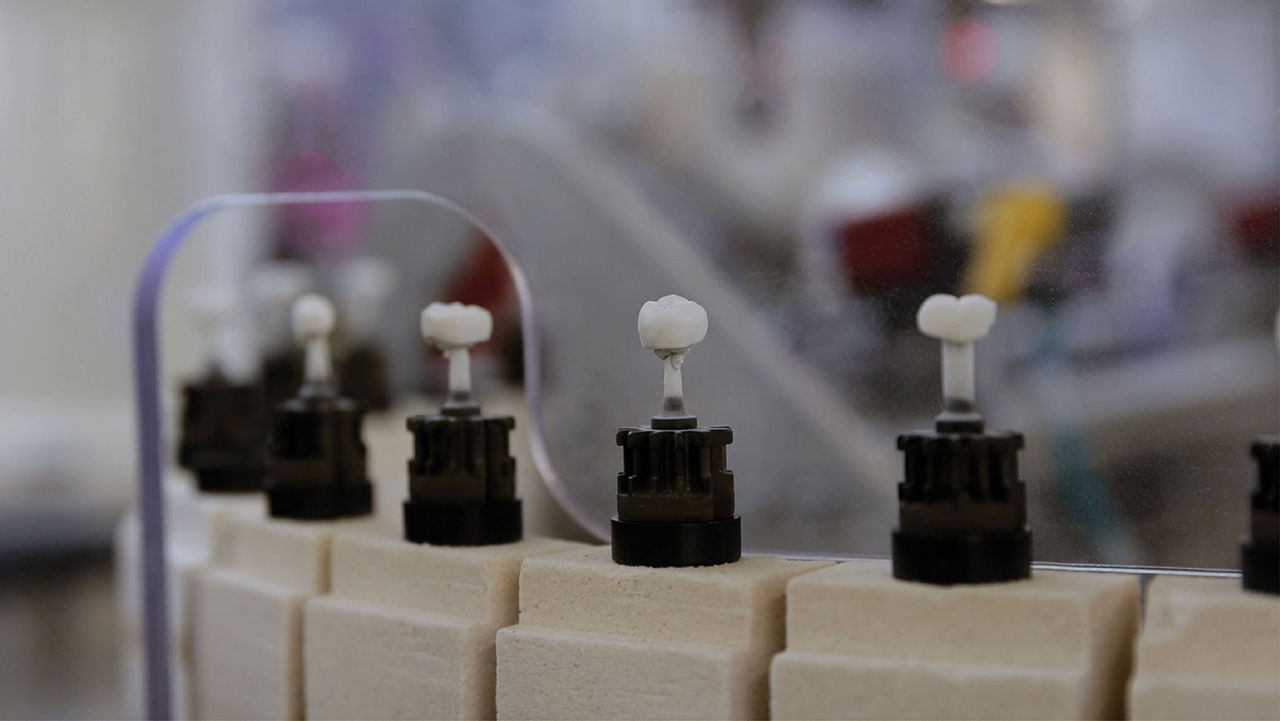
Three generations of the machine are running in our production today, glazing every crown that comes off our automated lines. A single machine handles 1,000 to 1,400 crowns per day with two operators, where the equivalent manual output would require a roomful of technicians and reintroducing all the variations we set out to eliminate.
The irony isn’t lost on us. The entire discipline of automation is built on standardization, on producing a known, predictable result every time. But a crown is a custom product, and our next frontier is teaching machines to deliver consistent outcomes in a world full of variation. As we aim to fill all gaps in mass customization, we have many irons in the fire, and Automatic Crown Glazing put us one step closer.
Every crown is still a snowflake. Our machine just learned to treat each one that way. Using robotics and AI, we can now guarantee a consistent glaze thickness regardless of individual morphology, ensuring precise contacts and swift seating.
Send us your next case and feel the difference a controlled finish makes.
Send blog-related questions and suggestions to hello@glidewell.com.
/GL-DB-6859919-080426-1.jpg/_jcr_content/renditions/thumb-jpeg-mobile-full.jpeg)

2201 Dupont Dr., Irvine, CA 92612
© 2026 Glidewell. All rights reserved.