
2201 Dupont Dr., Irvine, CA 92612
© 2026 Glidewell. All rights reserved.
800-854-7256 USA
An inside look at how Glidewell's quality-control systems and manufacturing technologies catch imperfections before they ever leave the lab.


As a dentist, you know the frustration all too well: a crown arrives that’s just a little off — contacts too heavy, occlusion light, or worse, the wrong unit entirely. Chairside adjustments eat into your schedule, patients leave less than thrilled, and remakes mean rescheduling and lost productivity.
What if every restoration you received fit within tolerances so tight that adjustments became the exception rather than the rule? What if your lab could trace every detail of production back to the exact mill, operator, or process step that created it — and fix issues before they ever reach your office?
At Glidewell, we’ve turned that vision into reality through dimensional quality control (QC) powered by high-precision 3D scanning and a fully automated closed-loop manufacturing system. In a recent conversation with Kunal Patil, manager of automation engineering and a 14-year Glidewell veteran, we got an inside look at how these technologies work together to ensure the daily production of thousands of restorations with unmatched consistency, speed, and traceability.
This isn’t theoretical lab talk. It’s the practical reality behind the BruxZir® Zirconia restorations you prescribe every day, delivered with fit accuracy that eliminates surprises, minimizes chair time, and gives you and your patients confidence in every case.

Dimensional QC is the cornerstone of quality assurance in Glidewell’s digital factory. After a restoration is milled, pre-colored, sintered, and prepared for final finishing, it must pass through our proprietary Dimensional Scanning Machine (DSM). There, every unit undergoes a full 360-degree 3D scan that generates a detailed point-cloud model of the physical crown.
This scan is then compared automatically against three critical digital files pulled from our exhaustive data cloud:
Patil explains: “When we scan the crown, we compare the resulting point clouds with the various digital files. So it will tell us whether the margins, contacts, occlusion, and specific morphology are within acceptable tolerances. If not, the system rejects it.”
Maximum tolerances are measured in microns, or hundredths of a millimeter — fractions of the thickness of a human hair. And the data shows even tighter real-world performance: approximately 70% of all crowns exhibit tolerances equal to just three one-hundredths of that allowable maximum. Color-coded maps make any deviation instantly visible — green for perfect alignment, blue for too small, orange for too big.
This level of precision directly addresses the limitations of manual QC. In the old days, technicians compared restorations to stone models by eye or with basic calipers — subjective, time-consuming, and prone to human error. Glidewell’s dimensional QC replaces all that with objective, machine-driven verification. The result? Fewer remakes, higher first-try success rates, and restorations that consistently meet or exceed the fit standards you expect.
The system also prevents one of the biggest headaches in the industry: the wrong crown arriving at your office. Tracking features on every unit enables the DSM to flag any mismatches that might arise between a crown and its digital file due to the occasional human handling. “If that happens, we don’t waste time trying to track down the right crown,” Patil notes. “We simply kick that case out and re-mill it, so that we don’t end up sending the wrong case. That’s always the biggest inconvenience for the dentist.”
For you, this means virtually zero risk of opening a case and realizing it’s for the wrong patient or tooth. For your patients, it translates to a seamless delivery appointment — no surprises, no delays, and a restoration that feels like a natural part of their mouth from the first try-in.
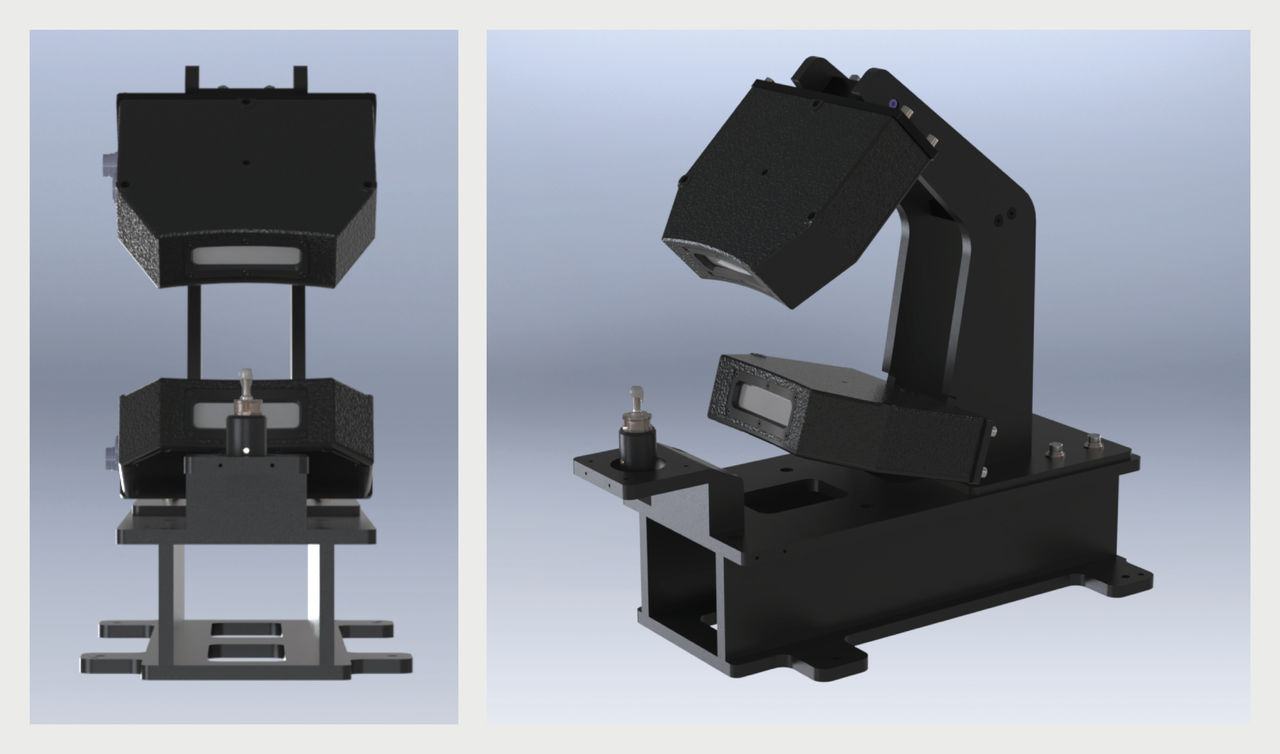
Glidewell didn’t arrive at today’s system overnight. The original dimensional QC station took roughly two minutes to scan each unit. Two parallel stations were needed to keep pace with production, delivering an effective throughput of about one minute per crown.
The current station, built in-house, costs significantly less to produce while delivering superior performance. The full 35-second scan cycle, including mesh generation and comparison, fits comfortably within the 40–50 second rhythm of units arriving from the milling center.
This speed matters at scale. Each BruxZir Automation line (lovingly referred to as a “BruxZir Factory”) is engineered to produce 2,000 units every 24 hours. “We’ve already hit 4,000 units across both lines on multiple occasions,” Patil claims, “with hours of spare capacity.” Every second saved in QC compounds into thousands of additional high-quality restorations produced annually — meaning faster turnaround for your cases.
Dimensional QC isn’t a one-way inspection gate. It’s the heart of a true closed-loop manufacturing system — the kind of intelligent, self-correcting automation that defines Industry 4.0 in dentistry. Every scan result, every deviation, every pass/fail decision is sent back to our data cloud in real time. That data then serves to drive immediate, automated corrective actions across the entire production ecosystem.
Here’s how it works in practice. If a crown comes out consistently too large or too small, the system traces the issue back to the specific mill responsible. “If a particular mill is making consistently bigger crowns or smaller crowns,” Patil explains, “the system will automatically remove that mill from production. People don’t have to intervene.”
The cloud-based intelligence then triggers an automatic calibration sequence, calculating precise offsets, and pushing corrections back to the mill — all without halting the broader factory flow.
If calibration doesn’t resolve the issue, the system escalates intelligently. It integrates with Glidewell’s maintenance app to generate work orders automatically. Service technicians anywhere on campus receive instructional push notifications. The goal is to resolve issues in less than 15 minutes. If resolution is going to take longer, technicians can swap in a spare mill and repair the original offline. Production never stops.
This closed-loop approach eliminated the chaos of the early days. “When we started BruxZir Factory, there used to be at least two technicians,” Patil recalls, “bombarded with a lot of work. Mills would go down and then wait until someone took action to bring them back online. So we automated that. Today, you don’t see anyone running around.”
The feedback loop extends even further. Data from dimensional QC is correlated with customer feedback — evaluation slips or remakes you send back with notes about fit or shade. Our system maps every returned case to the exact equipment, operator, and process steps involved. Spikes in remakes from a particular mill? That machine is automatically flagged and removed from service. The result: remake rates trending toward our ultimate target of 0%. For you, that means fewer adjustments, greater case acceptance, and fewer second visits.

All of this intelligence is visible through dashboards developed in-house and accessible across the Glidewell campus. Live views show queue sizes, current production, downtime reasons, and even individual operator performance. You can drill down to specific mills, see hourly reject trends, or review 3D color maps of any scanned crown.
One particularly powerful view shows statistical distribution trends across thousands of units. “We can see right over here … the orange there is where it’s trending bigger. It’s only a few microns,” Patil points out, “but when we see that our process is shifting, we can go figure out why it’s happening and prevent it from getting worse.”
This traceability gives us at Glidewell — and by extension, you — unprecedented confidence. Even if a rare issue slips through, our system can trace it, correct it at the source, and prevent recurrence. The system also feeds into broader enterprise tools, with direct integrations planned for inventory and efficiency tracking.
Interestingly, our approach has drawn visitors from unexpected places. External technology companies have sent teams to tour the factory, impressed by the PLC controls, connectivity, and 100% data traceability we’ve achieved. Patil notes, “The engineers from a prominent aerospace manufacturer were asking a shared vendor about data implementation, and the vendor said ‘Glidewell has already done it.’ ”
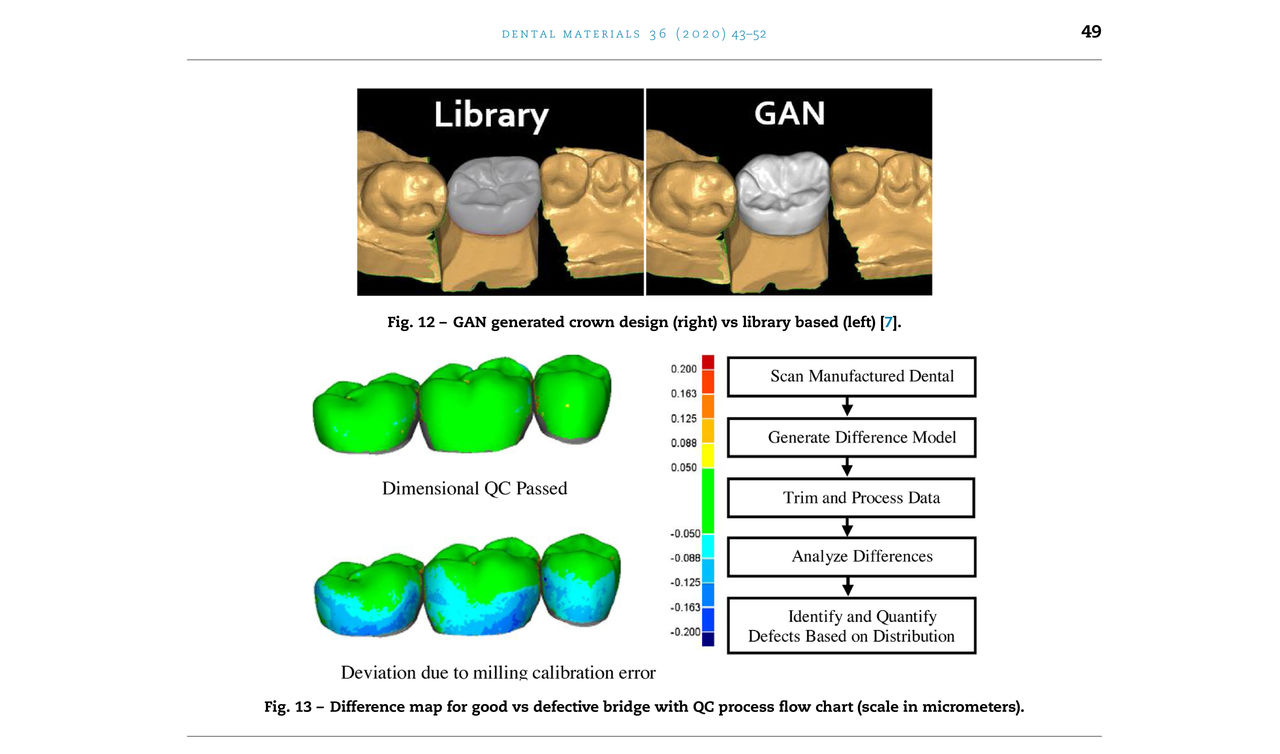
Much of the foundational thinking behind these systems was laid out several years ago by David Leeson, Glidewell’s executive vice president of engineering, manufacturing and R&D. In his whitepaper, “The Digital Factory In Both The Modern Dental Lab And Clinic” (published in Dental Materials, 2020), Leeson describes the shift to automated scanning and comparison of finished restorations against original designs — precisely the dimensional QC process now running at full scale in our BruxZir automation lines.
Leeson’s work outlined how Industry 4.0 principles — real-time data, closed-loop feedback, and elimination of human variability — could transform dental manufacturing. Today, that vision is live, producing restorations with the consistency and precision that directly benefit your daily practice.
When dimensional QC and closed-loop manufacturing work together, the benefits cascade straight to your chair:
Patil summarizes: “We basically looked at closed-loop manufacturing. Like when the crown comes out, dimensional QC actually inspects it. And then we feed that information back to the mills to correct themselves. No human intervention.”
Autonomy doesn’t replace the human touch — it replicates exacting human standards and amplifies overall value. Our technicians and engineers focus on higher-value work while the factory runs itself smarter every day.
At Glidewell, we believe the future of dentistry is digital, automated, and relentlessly precise. Dimensional QC and closed-loop manufacturing aren’t just fun laboratory innovations — they’re the reason your next BruxZir restoration will fit better, arrive faster, and remain affordable despite inflationary pricing pressures.
Ready to experience the difference? Submit your next case through our digital workflow and see the precision for yourself. Your patients — and your practice — will thank you.
Send blog-related questions and suggestions to hello@glidewell.com.

2201 Dupont Dr., Irvine, CA 92612
© 2026 Glidewell. All rights reserved.