
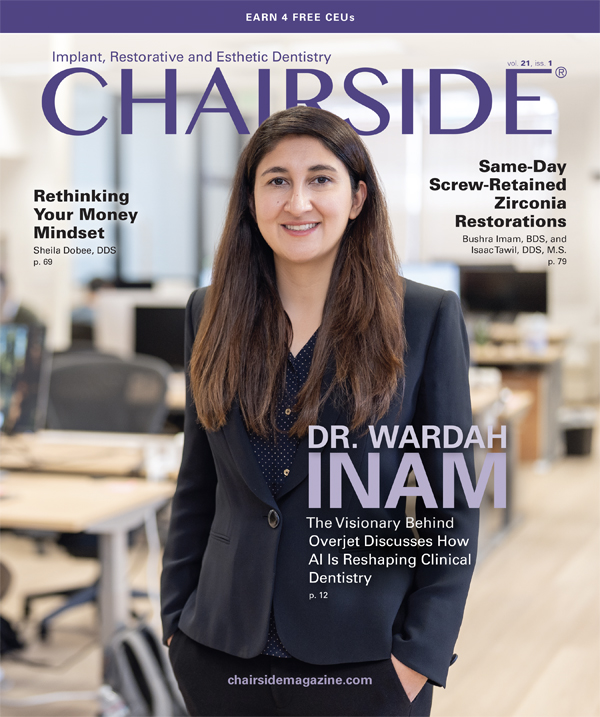
In this issue:
Rethinking Money: How Your Mindset Shapes Patient Care and Case Acceptance
Author
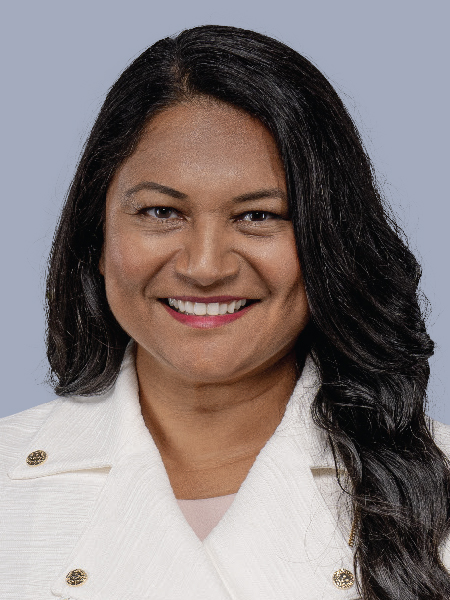

We all have one particular relationship that’s influential, powerful and deeply subconscious. This relationship shapes many choices we make, the happiness we feel, and — whether we realize it or not — how successful we are as dentists. That relationship is with money.
For most of us, it’s not something we talk about openly. But the truth is, how we think about money directly affects how we present treatment, how our patients respond, and ultimately how much care we’re able to deliver.
MRS. JONES AND THE $65,000 POOL
A few years ago, I had a patient come in chatting excitedly about resurfacing her swimming pool. Mrs. Jones was spending $65,000 to refurbish it. I thought to myself, “That’s insane!” When I took her X-rays, a large carious lesion showed up, and I walked her through the restorative treatment she needed: “You’ve got a big cavity here. This tooth needs a crown. If we don’t treat it soon, it’s going to break. Then, you’ll need an extraction and an implant, which will cost much more, so let’s get this crown done.”
I showed her the X-rays and images and explained the risks, the logic, and the value. She nodded and we were good to go. When I inquired later at the front desk about scheduling her crown, I was told, “Mrs. Jones said it was too expensive.” What? She’s spending sixty-five grand on a pool, but my crown is too expensive? I took it personally. I was frustrated, but that experience helped plant the seed that later changed my entire perspective.
THE PATIENT THAT SAVED THE DAY
Around that same time, Carmen came in — a housewife wearing old dentures that somehow stayed in place, though I couldn’t quite understand how. She had a flat ridge, and I immediately knew she was the perfect All-on-X candidate.
Unfortunately, I was concerned she wouldn’t be able to afford the treatment. I didn’t want to make her uncomfortable, so I whispered, “It will cost you around $65,000.” Then, without missing a beat, I added, “But I can give you a great discount to bring the cost down to $40,000,” and I quickly steered the conversation back to dentures. I told her about the new adhesives, how they hold better now, and how she could make them work comfortably. At the time, I thought I was helping her find an affordable option.
Two weeks later, Carmen walked into my office holding a $40,000 check. That moment hit me like lightning. I had decided for her based entirely on my own financial thermostat. I thought I was protecting her feelings, but I was letting my own bias about money decide the outcome. Have you ever prejudged what a patient can or can’t afford?
THE FINANCIAL THERMOSTAT
My parents emigrated from Mauritius to the United Kingdom when I was a child. My father couldn’t afford airfare, so we took a six-week cargo ship journey instead. I grew up hearing, “We can’t afford that.” Every purchase was weighed against sacrifice. If I wanted a toy, my parents would say, “You can have it, but then we can’t eat meat for a week.” That reality began to establish my financial thermostat at an early age.
When I opened my first practice, my crowns were priced at $700. I remember thinking, “Who’s ever going to pay for that?” Everyone has their own individual financial thermostat, and dentists are no exception. This thermostat is built from childhood messages, financial struggles and even dental school debt. If we don’t recognize it, it limits not only our income but also the care we provide.

MONEY MINDSETS IN DENTISTRY
Most dentists fall into one of three money mindsets.
The Scarcity Mindset
These dentists believe there aren’t enough patients, money or opportunities. They worry that people can’t afford treatment, so they discount heavily or avoid presenting full cases. They often rely on PPOs or HMOs, running on volume and stress. They are burned out because they equate being busy with being safe.
The Security Mindset
These dentists are financially stable but resist change. They attend CE courses but hesitate to implement new technology or invest in growth. They are comfortable, but they plateau.
The Abundance Mindset
This is where we should aim to live. Abundant dentists believe there are plenty of patients, resources and opportunities. They know their value and charge appropriately. They move beyond insurance limitations. They charge fees for service and focus on delivering excellent dentistry. An abundance mindset comes from understanding the value of the service you provide.
When I bought my second practice, I felt proud about charging $2,000 for a crown, until I met a colleague who charged $3,700. When I inquired about it, she told me a consultant once suggested she should lower her price, to which she replied, “I’d rather do two crowns than eight.” At that moment I raised my thermostat. It wasn’t arrogance; it was alignment. She valued her skill, and her patients valued her.
Many dentists are worried about dropping PPOs and HMOs because they fear losing patients. That may happen, but you are not going to be doing less dentistry because of it. Most of us don’t know our hourly overhead. When you add rent, staff, supplies, education, and loans, many practices cost $400–$500 per hour to run. That means a $200 filling may cost you money to perform. Understanding this simple math is liberating. It’s not about overcharging; it’s about charging appropriately.
CHANGING LIMITING BELIEFS
Reframing means seeing dentistry not as a cost but as an investment in overall health. When your inner voice says, “They can’t afford this,” challenge it.
Ask Yourself:
- What money beliefs did I inherit?
- Do they serve me or limit me?
- How do they show up in my treatment presentations?
- Is this my belief or my patient’s?
When you are talking to patients about dentistry, you want them to understand its value: “Mrs. Jones, your investment in this procedure is X, Y, Z.” When I changed my mindset, I didn’t just give Carmen new teeth; I gave her back her confidence. She told me later, “I’m not used to smiling all the time like I used to years ago. My confidence is back. Nothing’s keeping me home anymore.”
SUGGESTED READING


CHAIRSIDE MONEY TALK: MY FIVE-STEP PROCESS
The money conversation doesn’t have to be awkward. Speak openly. After all, if the patient trusts you as a person, they will trust you as a dentist.
1. Build the Relationship
Patients buy trust before they buy treatment. When someone sits in your chair, they might be anxious, skeptical or even embarrassed. You can shift that energy by asking the right questions:
- “Is there anything fun going on in your life right now?”
- “How are your kids? (You look too young to have grandkids)”
- “Any hobbies or plans you’re excited about?”
These light, genuine questions activate a different part of the brain, the one that feels safe and at ease. Once a patient feels comfortable, money can become part of a conversation, rather than a confrontation.
2. Empathy and Understanding
You want to understand what is important to your patients. Get curious, invest time with them. I spend up to an hour with every new patient just talking: no drill, no chart, just connection. That helps build the foundation for case acceptance.
Empathy isn’t just about caring; it’s also about understanding. In an emergency, when a patient says, “This tooth has kept me up all night,” don’t jump straight into the treatment plan. Acknowledge their experience and offer an “I’m so sorry that you’re having pain in that tooth. Let’s see what we can do about that.” You can get a feeling for what to do and what not to do depending on the answer to the question, “Have you had any outstanding dental experience, or any experience that has been really negative?”
If they’re hesitant about cost, ask what’s important to them in their dental care. The answer may not be about money; it might be about fear, trust or timing.
3. Urgency and Loss Aversion
People are more motivated by fear of loss than they are by gain. I focus on the consequences of inaction, not in a fear-based way, but in relatable terms.
Instead of saying, “You need this crown, or the tooth will break,” say, “Your teeth are showing signs of premature aging.” Everyone understands aging, and no one wants it to happen prematurely. In a malocclusion case, I might say, “Your teeth are in trauma; they’re hitting in ways that cause microfractures. Let’s realign them to protect your smile.”
One of my favorite and most used phrases is “I’m concerned.” Patients never want to hear that a dentist is concerned about something. I use it sparingly to slide into next steps and treatment considerations.
4. Presentation and Close
This is where the psychology of communication is very important. We need to respect the patient’s decision and avoid overwhelming them.
When presenting treatment, environment matters. Be sure you are isolated from other patients. Sit eye to eye with your patient and mirror their tone and pace. Do not whisper prices. Not only will they have a hard time hearing you, but they may assume they should feel guilty about spending.
Learn to apply techniques like price juxtaposition. When you mention a higher number first, the final cost feels more reasonable. For instance, “Comprehensive aligner treatment can run up to $10,000, but my team can review the exact cost.” When the front desk tells them it is $6,700, it sounds much more reasonable.
Always normalize financing. Say, “Most patients, like you, choose to finance this.” That single phrase, like you, creates comfort and social proof.
5. Follow Up
Be aware that a “no” today could turn into a “yes” tomorrow. Have your team call with concern, not pressure: “Dr. Dobee wanted me to check in because she’s worried about that tooth we discussed.” Patients remember that care.

FINAL THOUGHTS
Looking back, I sometimes wonder what would have happened if I hadn’t challenged my beliefs that day when Carmen came in with a $40,000 check. Would she still be struggling with loose dentures? Would she still hide her smile? By changing my belief system, I changed her life — and my own.
We don’t just restore teeth. We restore confidence, dignity and the joy of living. We must stop assuming what patients can or can’t afford and start believing in the true value of what we do. We create the space for transformation, one conversation and one patient at a time.